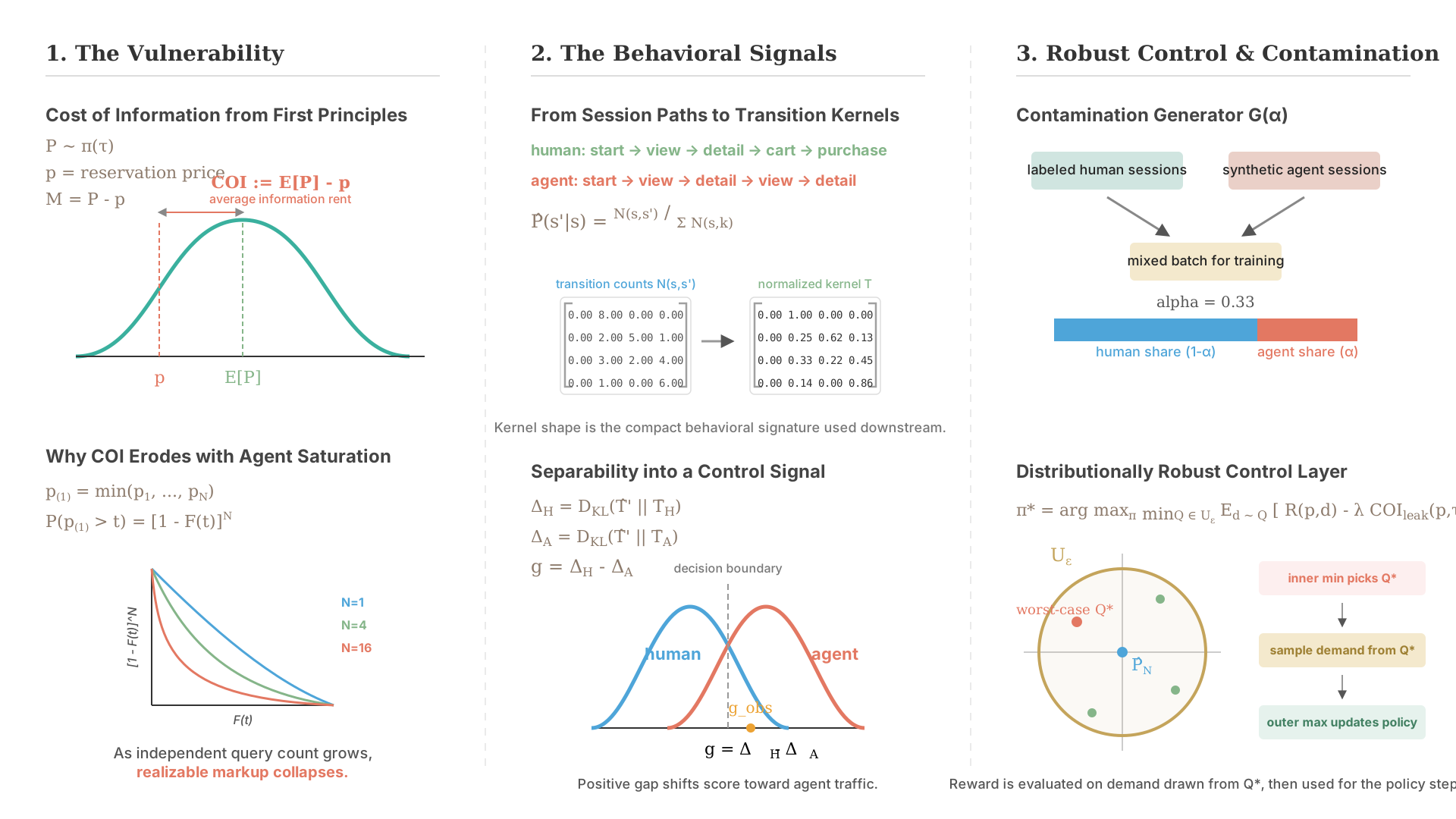
The vulnerability
Repeated agent price queries collapse the Cost of Information that dynamic pricing depends on.
Latest public build of the full thesis document.
IE University, 2025Monorepo with paper source, platform code, and experiments.
Open SourceOperator setup, configuration, architecture, and research pipeline (MkDocs).
PlatformReusable storefront and logging layer released for replication.
Public ArtifactPublic deployment of the hotel-style experiment interface.
Live DemoPublic deployment of the airline-style experiment interface.
Live DemoBehind-the-scenes posts covering thesis process, tooling, and insights.
To Boldly CodeTask definitions used to assign actor objectives in experiments.
Experiment DesignRepeated agent price queries collapse the Cost of Information that dynamic pricing depends on.
Human and agent sessions separate through transition-kernel behavior, not brittle bot flags.
Distributionally robust RL preserves pricing power under contaminated demand.
Dynamic pricing extracts margin by exploiting the gap between what a platform knows and what a buyer knows. A user who browses a hotel across several sessions signals intent; the platform raises the price accordingly. That information asymmetry — the Cost of Information — is the economic engine behind session-based pricing in travel, hospitality, and e-commerce.
LLM agents break the engine. An agent conducting reconnaissance in isolated sessions accumulates zero demand signal, then routes the purchase through a clean session at the floor price. As the number of independent querying agents grows, the realizable price converges to its minimum order statistic and COI collapses to zero. This is not a future risk; it is a structural failure mode in any pricing system that treats sessions independently.
PHANTOM formalizes the failure, measures it on real human and agent interaction data, and builds a defense. We prove the COI erosion theorem, collect 29 labeled sessions (13 human, 16 agent) across hotel and airline storefronts under goal-driven tasks, learn class-specific Markov transition kernels, and train a Distributionally Robust RL pricing policy over a Wasserstein ambiguity set. Behavioral separability is statistically significant (Mann–Whitney U = 2.0, p = 0.0006). The per-session agent probability signal f(τ) feeds directly into the robust policy reward as a COI-leakage penalty.

Have new needs and means of research & acquisition.

Use browsers (C/BUA) to look human and create clean sessions.
Run standard pricing algorithms and experience revenue loss.
Cost of Information — the expected premium dynamic pricing earns over the reservation price — collapses to zero as the number of independent querying agents grows.
Human participants and LLM agents complete goal-driven hotel and airline tasks. The storefront records behavior events and price quotes as timestamped trajectories.
Session paths become transition kernels. KL distance to human and agent prototypes yields a continuous agent-probability signal.
A contamination generator mixes human and synthetic agent trajectories. A distributionally robust RL policy optimizes price under worst-case demand shifts.
Our solution can be forward-deployed to any e-commerce platform to preserve their COI.
~4k rows of labeled human and agent interaction data across hotel and airline tasks. Open dataset used for training the behavioral kernels.
huggingface.co/datasets/velocitatem/whoclickedit@thesis{Rosel2025PHANTOM,
title={Pricing Heuristics Against Non-human Transaction Orchestration Mechanisms},
author={Rösel, Daniel},
school={IE University},
year={2025},
address={Madrid, Spain},
type={Bachelor's Thesis},
note={Advisor: Alberto Mart{\'i}n Izquierdo}
}